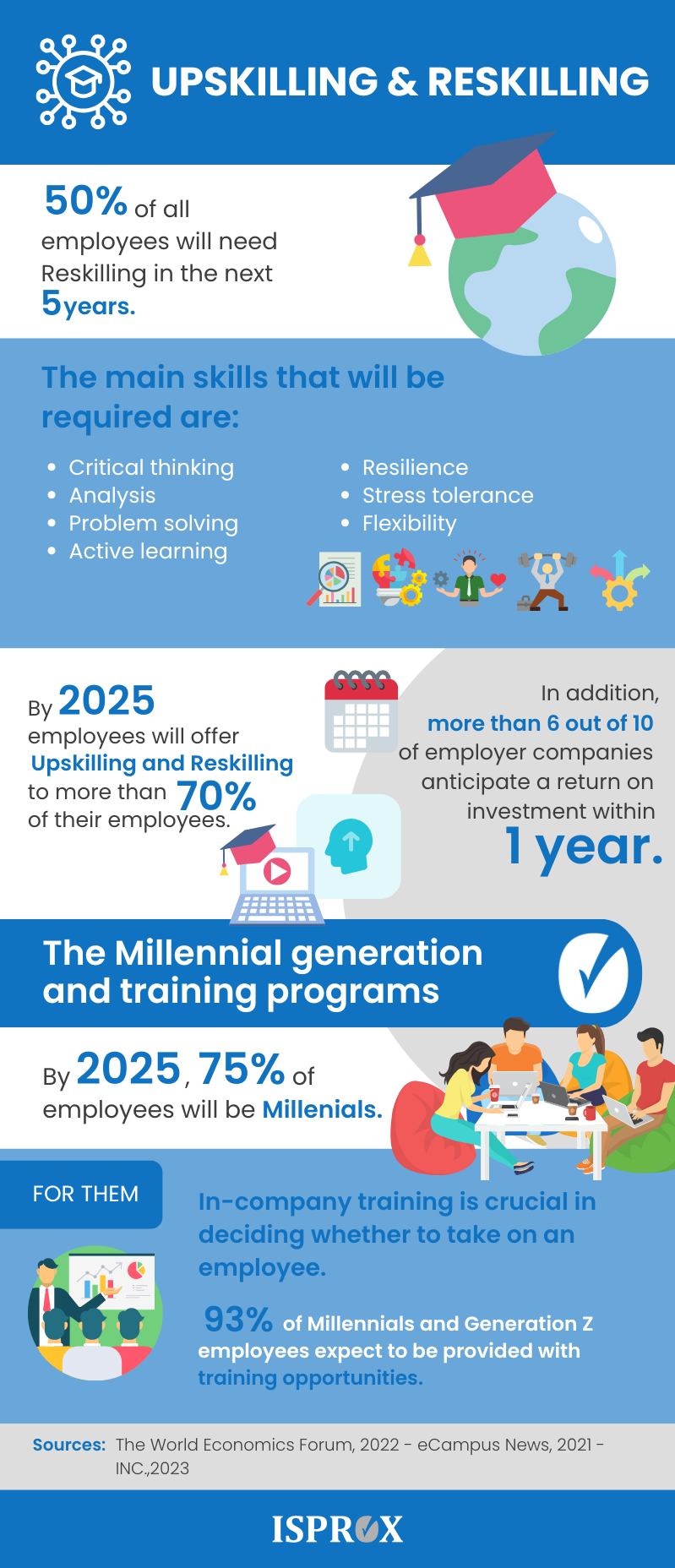
What is the main difference between upskilling and reskilling? The answer is simple: the approach, although both processes are essential in the world of work. The two are interrelated and ensure that professionals are prepared to meet new challenges and opportunities in the workplace. They must be prepared through continuous learning or by adapting to new demands that are essential to thrive in the future. A future of upskilling and reskillingis already here.
What is upskilling and reskilling?
These are two terms related to education and skills development but have different approaches and objectives.
What is upskilling?
Upskilling consists of keeping up with the latest advances and trends in the field or position in which the individual is already working, enabling him or her to become more competent and efficient.
The literal translation would be upgrading, or in other words, improving skills. It is about acquiring new competencies that complement existing skills with the goal of remaining competitive in one's environment.
An example of whatupskilling is? A programmer who takes a course to learn a new programming language to improve the usability of his work is participating in an upskilling process.
Upskilling has become particularly relevant in the digital age, as the skills required in many industries are changing at breakneck speed. Technological advances, automation, and the changing demands of the job market make it critical for professionals to continually learn and update their skills. Only then can they stay prepared and relevant. This is where the critical difference between upskillingandreskilling comes into play.
This continuous learning process may involve education through courses, training, and certifications. Or you may need to participate in professional development programs that provide the knowledge necessary to adapt to new requirements and trends in your industry.
Keep in mind that continuing education benefits not only the individual, but also the company or organization, as well-trained employees contribute to the growth and success of the business.
What is the meaning of reskilling and what does it consist of?
Reskilling implies a more significant change in a person's career path. It refers to the acquisition of different or entirely new skills to change job sector or performance. An example is a worker who has been displaced due to automation of her job in a factory. If she decides to become a renewable energy specialist, she is going through a reskilling process.
In an ever-changing environment, upskilling and reskilling are becoming increasingly important. Many skills and occupations are becoming obsolete, in some cases leading to an insurmountable dilemma: loss of employment or the need to change career paths.
Understanding what reskilling means can help you face the challenges of the coming years and ensure that operators, middle managers, and executives have the skills they need to advance. Or in other words, that they can make positive progress towards achieving their goals and growth in a variety of areas, whether personal, professional or financial.
Why does your company need upskilling and reskilling strategies?
If you are a manager, implementing upskilling and reskilling strategies is essential for your organization. There is no doubt about it. Today, the importance of hybrid work is fundamental to maintaining competitiveness, productivity and sustainable growth.
Remember that by investing in the development and upskilling of your workforce, you strengthen your ability to innovate and respond to market changes. It also creates a workforce that is more engaged and more valuable to the long-term success of the organization. In this way, you promote efficiency and optimize internal processes, leading to higher productivity and better quality in the delivery of products or services.
On the other hand, sectoral reskilling gives the company the flexibility to adapt to new opportunities in the sector to which it belongs. By having versatile and capable employees in different areas, it is possible to diversify their skills and explore new lines of business, reducing dependence on a single specialization.
In addition to securing a competitive position, upskilling and reskilling strategies are key to retaining talent and maintaining a motivating work environment. Employees value opportunities for professional development and career growth, contributing to greater job satisfaction and reduced turnover.
Are you looking for talent to expand your team?
At ISPROX we help you find the right profile, saving you time and increasing your hiring success rate.
Benefits of implementing upskilling and reskilling strategies
Once you understand what reskillingand upskilling are, there are a number of significant benefits to implementing their methods in your organization. While strategy is a general, long-term plan designed to achieve an important goal, in this case there are also very relevant tactics and specifics. The best way to explain this is to take a point-by-point look at upskilling and reskilling:
Improved competitiveness. By updating and improving employee skills, the company is better able to compete by having more qualified professionals.
Increased productivity and efficiency. More skilled employees are more efficient at their jobs, resulting in higher productivity in the day-to-day operations of the organization.
Adaptability to change. Ongoing training and the acquisition of new skills enable the company to adapt quickly to technological, economic or market changes, thus ensuring its long-term survival.
Talent retention. Providing opportunities for professional development and growth helps retain your most valuable employees, reducing turnover and the costs associated with hiring and training new employees.
Diversification of capabilities.Upskilling and reskilling enable the company to diversify its expertise and open up new opportunities in different business areas. The result is valuable expansion and development.
Innovation and creativity. Upgrading upskilling and reskilling encourages innovation and creativity, as employees are better trained to generate new ideas and even contribute solutions to various business obstacles.
Positive brand image. Investing in internal professional development enhances a company's image. It makes the brand one that is committed to the growth and well-being of its entire team.
Increased job satisfaction. Employees who have the opportunity to improve and grow in their careers tend to be more satisfied with their jobs and more committed to the company.
Preparing for the future. Ongoing training and the acquisition of new skills and competencies of upskilling y reskilling ensure that the company is prepared for the future and can face various disruptive changes with confidence.
Upskilling and reskilling examples
To move from the theory of upskilling and reskilling to the practice, nothing works better than real examples. Remember that personalization is the main identification mechanism for creating meaningful connections. Therefore, in the following, the two processes, upskilling and reskilling, are divided and professional activities in 5 different countries are detailed: Spain, France, Portugal, the Netherlands and Mexico.
Real examples of upskilling and reskilling of workers
Take note.
An HR professional who enrolls in a talent management and recruiting learning upskilling program to stay current with HR best practices. .
An engineer specializes in artificial intelligence through a trainingupskilling program to drive technological innovation in your company.
An accountant enrolls in a training upskilling program to become a tax advisor, enabling him to offer more specialized services to his clients. Or the case of an employee working in the oil industry who takes a course in renewable energy to change sectors and work on clean energy projects.
A data analyst takes a machine learning course to improve his predictive data analysis skills.
A physician specializing in telemedicine through a technical program to provide online health care services.
Upskilling and reskilling: the case of Amazon
Speaking of high-level examples, virtually all multinational companies have already implemented upskilling and reskilling programs. This is demonstrated in a prestigious article by Curtis Odom, Executive Professor at Northeastern University in Boston, on the analysis of technology stocks that are changing the world.
In this case, what began as an online bookstore founded in 1994 by Jeff Bezos, the e-commerce giant, can serve as a reference for you. Since the recent pandemic, the company has been helping its employees to change positions or acquire responsibilities and new tasks adapted to their needs. And its internal investment to do so is not trivial: $700 million. Four initiatives are under way:
Amazon Technical Academy: For employees to learn software engineering techniques.
Machine Learning University: Training in technological skills to enable employees to advance their careers.
Associate2Tech: Instruct in ICT-related functions.
Warehouse: Opportunities for distribution and logistics employees to perform more technical or IT development tasks.
Amazon also offers upskilling opportunities to its employees through its Career Choice program. It provides financial support for training in high-demand fields such as nursing, information technology, and mechanics.
Upskilling and reskilling in Latin America, the U.S. and the EU
The following example is about the Danish company Arla Foods, a dairy corporation that has applied upskilling to its 3500 employees. The results? Not only did it improve employee training, but it has increased its reputation at the European level. It has shown everyone that improving personal functions helps to maintain the workforce.
Something similar has happened at General Electric. With the GE Reskill fitness program, its employees have raised their digital and technology skills. Or at Accenture, which has managed to prepare itself for today's digitization demands by training its workforce in emerging technologies and advanced consulting.
In the case of JPMorgan Chase, the bank has also carried out reskilling initiatives to train its entire staff in machine learning and artificial intelligence. SAP, on the other hand, has launched programs in the cloud and data analytics areas, so that its workforce can better support end customers.
Upskilling and reskilling at AT&T: the leading U.S. phone carrier
One last interesting case of upskilling andreskillingwith real examples. Back in 2013, AT&T was a pioneer in combining both processes. Since then, with an investment of $1 billion, its Workforce 2020 program continues to focus on internal development. To do so, it hired an expert talent search consultancy, with one main objective: to provide opportunities among its staff in critical areas (especially, in cybersecurity).
In fact, it continues to use two upskillingandreskilling tools to facilitate this process. The first allows users to create professional profiles, which helps them identify internal opportunities. The second tool, on the other hand, provides information on hiring trends, enabling employees to stay informed about career development opportunities inside and outside the company. Through this reskilling and upskilling strategy, AT&T empowers its workforce, improves its responsiveness to technology demands, and leverages internal potential for growth and continuous innovation.
As you have seen, the unstoppable transformation to the digital universe and the emergence of new trends make the use of these techniques, upskillingandreskilling, a must for any company. Both organizations and workers are forced to a win-win improvement to keep up with all the changes happening around them and that no part is left behind. Where will the future ofupskillingandreskilling take us?
¿Te resultó interesante este artículo? ¡Compártelo con tu red!

.svg)
 Spanish - Spain
 Catalan
 English
 Portuguese
 French
 Spanish - Mexico