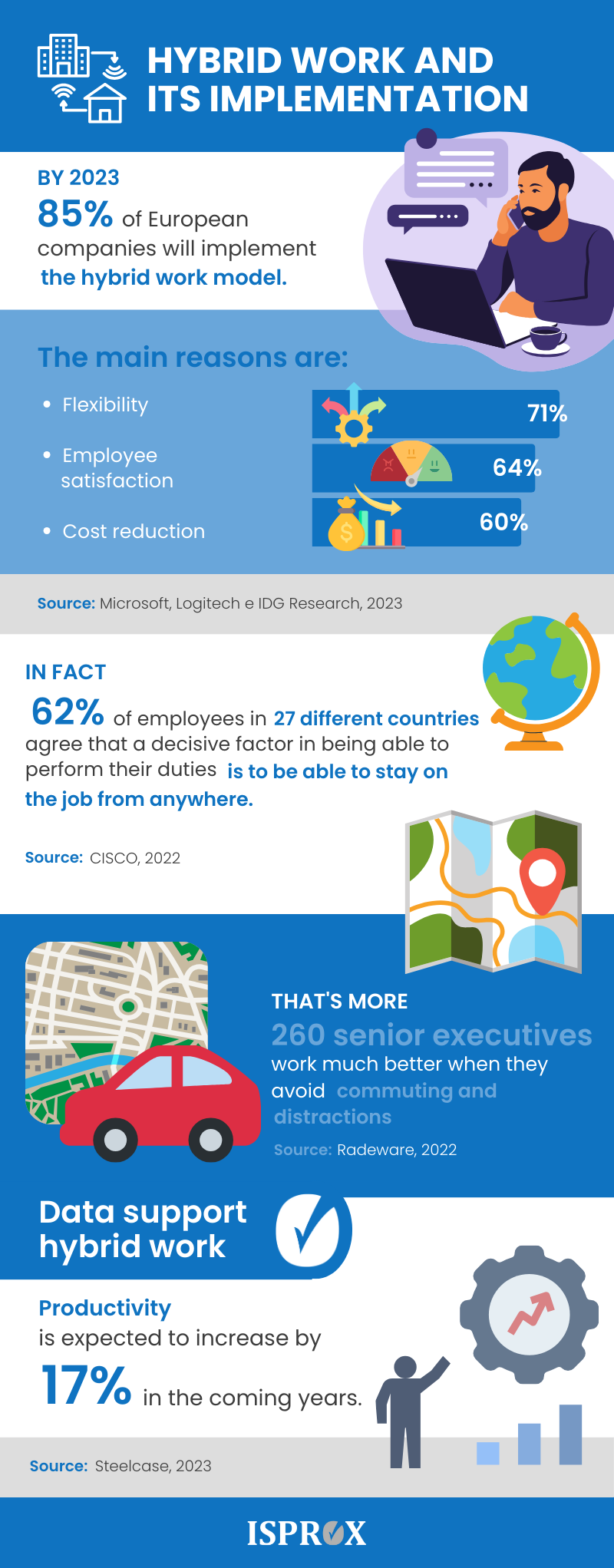
Forecasts and studies indicate that by 2023, 85% of European companies will adopt the hybrid work model due to its benefits. These are the results of a study conducted jointly by Microsoft, Logitech and IDG Research.
Thecoronavirus health crisishas brought about many changes in the business sector. Telecommuting began to play a more prominent role, a trend that is here to stay. The study shows that the main motivations are flexibility (71%), employee satisfaction (64%) and cost reduction (60%).
In this article, we will tell you exactly what hybrid work is, what its benefits are, and how to implement it effectively in your organization.
What
The hybrid work model is an option that allows the employee to perform his or her tasks both inside and outside the office, and it can occur in different ways, which we will specify below. Broadly speaking, the meaning of hybrid work has to do with the combination of face-to-face work with the possibility for the employee to work remotely, i.e. from home or any other place. This gives them greater flexibility and the ability to balance their time with their commitments or family responsibilities.
The transition to a hybrid work model has been underway in many organizations for several years. The emergence of new business models and advances in technology, from smartphones to cloud storage, have made hybrid work possible.
Today, many professionals need only a laptop and a mobile device with an Internet connection to get work done. Hybrid work models also mean significant savings for both the employee and the company.
Are you looking for talent to expand your team?
At ISPROX we help you find the right profile, saving you time and increasing your hiring success rate.
Once we have a clearer understanding of whathybrid work is, it is also worth highlighting the difference with remote work.
While hybrid implies that an employee can complete work tasks both in the office and at home, the remote model implies that an employee works only from his or her own home or any other location of his or her choosing. The important thing is that he or she gets the job done on time.
This type of model is also becoming very popular, especially due to the large number of emerging professions in the technological field, whose professional profile tends to prefer this model.
This is the main difference between hybrid and remote work, although there are companies that implement all options. It depends mainly on the industry, activity or business philosophy. There are many marketers, creatives, programmers, and copywriters who prefer these modalities to face-to-face work, so it may be interesting to include these modalities as a strategy for attracting and retaining talent.
Hybrid working models: types and characteristics
There are different hybrid work models, depending on business needs. Here is a list of what they are and how they differ.
Flexible hybrid work: The employee chooses, according to his or her priorities, his or her location and working hours.
Fixed hybrid work: The company is the one that establishes the days and schedules that the employee must comply with both in the office and remotely.
Hybrid office work: Most of the time, the employee performs his face-to-face work in the office. However, he/she can combine it with some teleworking days.
Hybrid remote work: It would be the opposite of the previous modality, since the preference would be for remote work and, occasionally, face-to-face work.
These four proposals are feasible, as long as the hybrid work meets a series of characteristics, as specified below:
FlexibilityHybrid work is generally conducive to greater organizational flexibility. It also helps the company to be more competitive in its industry.
New technologies. It is necessary for any company to have the technology and tools that favor remote work and good internal communication.
Employment support. An employee who works from home needs the same support as one who is in the office. Therefore, organizations need to encourage this mindset to make employees feel comfortable and integrated.
Effective management. Hybrid work is dynamic and can involve some management complexity. It is necessary to have resources that promote effectiveness, such as establishing specific policies and guidelines, and communication and collaboration systems for employees.
How is a hybrid workday structured?
The hybrid working day will depend mainly on the organization of each company and its needs. Even conditions may vary in the winter and summer months:
Split schedule. The workday is divided into mornings at the office and afternoons at the remote office.
Day distribution. Another option is to divide the days of the week between the two parties. For example, following the 3:2 model (3 days in the office and 2 days at home), you could have face-to-face work on Monday, Wednesday, and Friday, and remote work on Tuesday and Thursday.
Seasons. There is also the possibility of distributing work time over weeks or months in the office or remotely.
In short, this work proposal favors work-life balance and, at the same time, does not imply a total disconnection from the work environment, which contributes to improve employee satisfaction and talent loyalty.
Strategies for effectively managing a hybrid workday
A report published by Cisco highlights that there is no going back to the way work was done before the pandemic. Sixty-two percent of employees surveyed from 27 different countries agree that the ability to perform work functions from anywhere is a critical factor in staying employed. However, there are a number of strategies to manage these work teams effectively and successfully.
Frequent team meetings
In line with the previous point, it is worth noting the need for more frequent work meetings. Also, if the supervisor has to spend more time with an employee who works remotely, it will be beneficial for their progress and that of the company. The idea is for companies to set up face-to-face meetings for the entire workforce to share experiences and viewpoints.
Implement an effective communication system
This is essential in any organization for good working relationships and understanding between managers and employees. Therefore, if an employee is going to work from home, he or she should maintain fluid communication through video calls, email, corporate chats or Telegram or Whatsapp channels.
Study the employee's profile
Not all job profiles have the same skills to perform their work remotely with the same guarantees of success. Some people are much more organized and productive when working remotely. On the other hand, there are other employees who find it more difficult to concentrate or do not have a suitable place to work.
Time optimization
One of the most important factors in hybrid work has to do with proper time management. For example, a good idea is to control working hours through effective support. It is best to use a specific software or program such as Sesame, Bizneo or Personio. This will also be of great help for the person to know how much time he/she spends in a hybrid workday.
Steps to implement a hybrid work model in your organization
If you work in the human resources department or you are an entrepreneur, you may be interested in implementing hybrid work, considering the high percentage of companies that already benefit from hybrid work. Here are some tips to help you get the best results.
Investment in technology. Organizations that decide to opt for this work model must invest in technological and IT tools, such as software to work in real time and in a reliable and secure manner.
Market research. On the other hand, it would not be a bad idea to carry out a preliminary study to find out whether competing companies work in this way. If so, it would be necessary to evaluate how they do it and what their results are.
Promote occupational ergonomics. If an employee has the freedom to choose where they prefer to work, they should also consider whether they have a comfortable workspace to ensure productivity. For example, silence, a suitable chair and table, or agile and secure IT equipment.
Job functions. According to a survey conducted by Radware, a leading IT security company, 250 senior executives work much better when they avoid commuting and distractions. However, this depends on each person's level of responsibility and the tasks they have to perform.
Timeline of activities. Similarly, it is very important for a company to list the number of activities that can be conveniently performed in-house or from home.
Examples of the implementation of hybrid work in different sectors
Many companies were forced to incorporate hybrid work in the wake of the coronavirus pandemic. Regardless of the number of workers and the size of these businesses, they had to adapt to this modality in order, in many cases, to survive.
It all began as a necessity to ensure maximum safety from the risk of contagion. However, the efficiency and advantages it offers led multinationals, franchises and SMEs to decide that it was the best alternative.
Case studies: companies that have successfully implemented hybrid work
There are some examples ofhybrid jobs that are a benchmark and deserve special attention to observe what led them to success by incorporating this trend. This modality has aroused greater interest in start-ups and technology companies. For this reason, let's get to know some of them and why it has favored them.
Google
If there is one thing this company is known for, it is for being one of the employees' favorites. Most of them work two days a week outside the office. This has been possible thanks to the incorporation of technologies and effective communication channels.
As you know, the company has different locations around the world, which has allowed employees to choose the destination they are most interested in or to work seasonally in other countries. Undoubtedly, labor flexibility is one of its main competitive advantages.
Microsoft
This multinational technology company is an example and is highly valued by its employees. One of its main characteristics is that it offers a system to evaluate the performance and increase the productivity of its employees. It is based on the premise that they are an essential asset for meeting objectives and goals.
Through this evaluation it is possible to know the individual work performance of employees and their potential. This periodic analysis helps each employee to grow professionally, as well as to feel much more satisfied and committed.
HubSpot
This software company, which specializes in marketing and sales, implemented hybrid work little by little. In fact, it presented several options to its employees and involved them in the decision-making process in order to meet their needs.
This company offered to come to the office in person three days a week with a space set up for the employee. Or to go twice without having a defined place, as well as to work most of the time from home, with occasional visits. The results translated into a better work environment.
Conclusion: the future of work is hybrid
In conclusion, most of the organizations that have implemented hybrid work have increased their productivity. In our country, more than 80% of companies are expected to include this modality and an overall productivity increase of 17% is expected in the coming years.
To conclude, Steelcase's research identifies the fundamental needs of employees as belonging, productivity, control, comfort and security.
¿Te resultó interesante este artículo? ¡Compártelo con tu red!
Usamos cookies propias y de terceros para fines funcionales, de preferencias, analítica y marketing.
Puedes aceptar todas, rechazar las no necesarias o configurar tus preferencias.
Política de Cookies.
Las cookies necesarias se usan siempre porque son imprescindibles para el funcionamiento del sitio.
Preferencias de cookies
Imprescindibles para el funcionamiento básico del sitio y la seguridad. Siempre activas.
Guardan tus ajustes como idioma o región.
Nos ayudan a entender cómo usas el sitio (por ejemplo, Google Analytics).
Permiten personalizar publicidad y medir su eficacia (por ejemplo, Meta/Ads).

.svg)
 Spanish - Spain
 Catalan
 English
 Portuguese
 French
 Spanish - Mexico