Are you actively searching for a job? Recruitment processes are changing. Technology is having a major impact, so you need to learn how to deal with alternative communication channels. Among them, the phone interview is becoming more and more common. Are you ready to succeed?
A progressive change
According to a TechUk survey, 58% of people want to improve their digital skills. In many cases, they want to access a better job or increase their chances of being chosen. But does this scenario include telephone contact? You should know that it is becoming a preferred tool during the interview process for job candidates. Therefore, you need to be good at this type of communication.
There is another interesting US study, this time from the Federal Reserve Bank of Boston. It found that workers who have been unemployed for more than six months have a harder time getting out of that situation. In other words, if you are unemployed, you have to be fast and smart.
Finally, Zety's data shows that between 30 and 50 resumes must be sent out before a candidate is hired. Take a look at this average data, it is certainly revealing:
10% of applications result in an invitation for an interview.
20% of those interviewed receive a job offer.
The success rate of applications ranges from 2 to 3.4%.
When this process includes a telephone interview, the lack of habit and specific preparation tends to reduce these percentages. It is true that we are all used to talking on the phone. But are we really able to persuade and inspire our interviewers?
Although we all make phone calls on a regular basis, we are not used to doing so under the pressure and demands of a job interview.
Telephone job interview: main characteristics
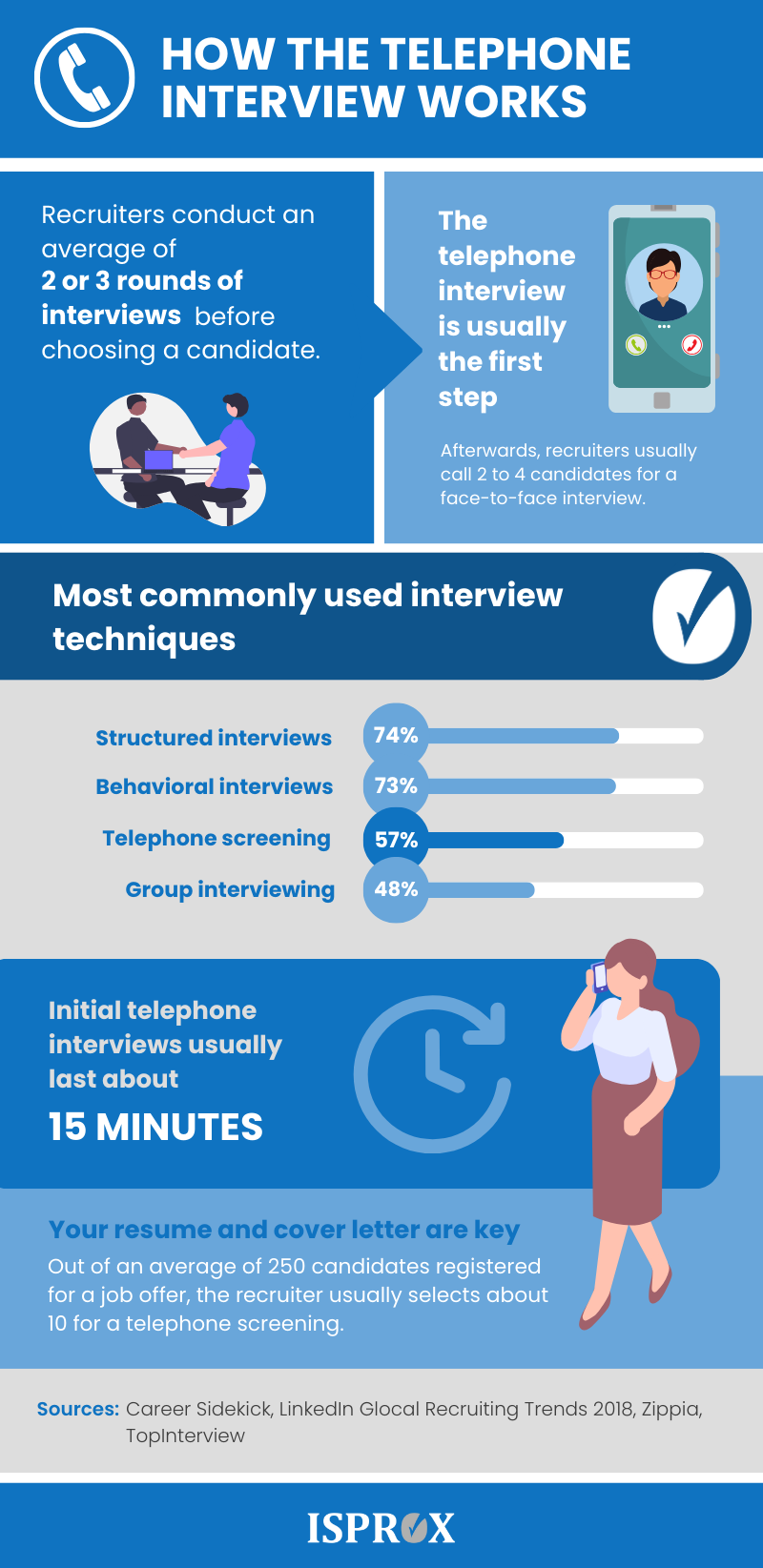
In most cases, the phone call becomes the filter before the in-person interview. It allows you to quickly identify and eliminate candidates who do not fit the profile you are looking for.
They are usually short, between five and ten minutes. They focus mainly on the analysis of the curriculum and its content. They almost always have a very clear purpose: to confirm the candidate's suitability.
Do not underestimate its importance, because it is the key for you to continue in the process or not. In this sense, it will be your first opportunity to seduce the company where you want to work.
Are you looking for a new job challenge?
Register your CV, and from ISPROX, we will contact you if any vacancy matches your profile.
We do not think it is so important to talk about the advantages and disadvantages of this kind of communication, what is really important is to know its characteristics. It depends on your preparation and attitude to make these characteristics positive or negative. You must adapt to its nature in order to shine and express your full potential.
Keep these factors in mind:
Body language is no longer visible. This means that you are not judged by your appearance, your wardrobe, or your gestures.
Extra-linguistic communication is still crucial. This is now shifting to factors such as voice, pronunciation, mumbling, and silence.
The interlocutors are separated by a technological barrier. As a result, it is more difficult to empathize, and the conversation is surrounded by a halo of coldness and distance
These calls are often unexpected. It is not common for them to tell you in advance when they are going to call. Therefore, they may surprise you in inappropriate situations. Your ability to react will be crucial.
It requires you to change your mind. You may be with your family, having a drink with friends, or concentrating on a demanding task when your cell phone rings. In any case, you need to identify the caller as quickly as possible and go into "promote your candidacy" mode.
Albert Mehrabian, professor at the University of California, is the author of a mythical study on personal communication. His work allowed him to formulate, in 1967, the famous and very useful rule 55-38-7 on the importance of nonverbal language:
55% of the impact of our communication comes from gestures and body language.
38% of this influence depends on verbal behavior, i.e. voice.
Only the remaining 7% comes from the words we say.
If we apply these conclusions to the specific case we are dealing with, the selection of personnel by telephone, the data have an impact. You have to achieve communication success with 45% of your resources, because body language disappears from the spectrum of influence. Your voice is therefore crucial.
To be successful on the phone, as in any communication, preparation and voice are key.
The importance of your voice
In all oral communication, the voice is the instrument par excellence that defines our personality and reinforces what we say. It is an element of impact, influence and power that must reflect security, confidence and enthusiasm.
However, there are two preliminary questions that you should consider:
It is an inherited gift, supervened. That means we cannot choose it a la carte, it is what we have. We can, however, improve and polish it.
Its emission has many subjective nuances. How we launch and project it always depends on our state of mind. If we are hesitant, it reflects weakness and mistrust. If we are jubilant, it spreads that enthusiasm.
In a telephone interview, it will be the key factor. What we say is not as important as how we say it. And, as we have just explained, intentionality is a priority. Your mood and inner conviction must support your conversational speech. Remember that your voice always shades your words with your emotions, and these are the words that reach other people's hearts, or not.
Factors such as tone, volume, intensity and breathing can be worked on to improve your telephone communication. Also the content of your messages, which we will talk about in a moment. But the most important thing is how you feel about sharing information. Work from the inside out and you will transmit the necessary positive energy.
Good habits for a telephone job interview
Remember, calls come when they come. You usually don't know recruiters are calling you until it's too late and they've introduced themselves. So if you are in the middle of a selection process, always answer every call with kindness, availability, and elegance. Maybe they're the ones.
In addition to this advice, you should apply other measures and habits that will help you increase your chances of success:
No matter how inconvenient the call may be, it is best to take it immediately. Delaying or refusing it may take you out of the selection. Find the calmest and quietest place in your environment and take refuge there. Politely ask the caller to wait a few seconds.
Already in the right place? Change your chip completely. Focus on the situation, the work process, and the company calling you. If you have been careful, you will have prepared and left home with a script. Use it, the interviewer can't see you.
Body language is not completely invisible. The person you are speaking to cannot see it, but they will hear it in your voice. So smile, gesticulate and reinforce the communication with your physicality. You can't imagine how much of a difference it will make! However, avoid unnecessary movement. For example, if you climb stairs while chatting, your voice will sound agitated, insecure, and tense, which conveys weakness.
Try not to interrupt the interviewer. Let him/her finish, and if you have any doubts, ask him/her before answering what he/she asked you.
Speak in moderation, without overwhelming with endless monologues or closing yourself off to communication with monosyllables. Listen well to questions and respond with openness, naturalness, and judgment. Watch your crutches and repetition of words. Although, to be honest, they will flow spontaneously in this challenging moment. Try to be yourself (yes, the best version of yourself).
Think about all the information you have included in your selection proposal. Do not hesitate or make mistakes. If necessary, bring your curriculum vitae and everything else along with your script, even if you have to leave the house each time with a small folder.
Say goodbye in a positive way to leave a good taste in your mouth. A touch of optimism or a friendly note will do the trick. Courtesy and politeness are essential at all times.
Be natural and be yourself on the phone with your recruiter. Being prepared will help you put your best foot forward.
Common questions and recommended answers in these interviews
Below are some common questions you will be asked during these phone interviews. You may be addressed as "usted" or "tuteo". Unless specifically asked, it is best to address the other party as "you. This is a time for respect, not trust.
1. How would you define yourself?
Do not improvise, you must have prepared this answer. Be measured and sincere, without bragging unnecessarily, but mention and explain your value with honesty. Emphasize what you bring to the job. Having researched the company beforehand will also help you filter which attributes you should highlight about yourself.
2. What is your educational background and would you go back to school?
Reinforce the idea that every educational experience has value and that, in your case, you took advantage of it. If you dropped out of college halfway through, see it as a test of character when you realized it was not for you. Remember, too, that the questions about your preferences are designed to measure your consistency with the job you are applying for. If you emphasize literature, art, or biology in an interview for an accounting or financial management position, you won't seem like a good fit.
It is important to listen carefully to the questions before deciding on the answer.
3. Have you worked until now? Why were you fired?
Be honest, based on what has happened. Flexibility is an increasing value, and we all know that these things happen. However, it is important that you have prepared this response: improvising can lead you to say outrageous things. If you badmouth your former employers, you're thinking that you can badmouth them, too. So never criticize your former bosses or colleagues. End your speech with a good or positive thing you learned from the situation.
Never speak ill of your former bosses or co-workers. Would you hire someone who criticizes people who have been important in your life?
4. How would you describe your best friend, your partner, your mother...?
There is something of a trap in these questions of a personal nature. It is not so much the content of the answer that matters, but the ability to deal with an unexpected situation. They are usually asked bluntly to change the pace and gauge your reaction. Answer calmly and positively. Again, it's not so much what you say as how you handle yourself.
5. What do you know about our company and why would you like to work for us?
Again, an answer that requires preparation. The information you have gathered will allow you to make the connection between their way of working and your personal style. Express your sincere interest in joining in win-win terms. Subtly demonstrate that you know what you are talking about and that you are a candidate ready to perform and add value.
6. Would you be willing to move to another city or country?
Geographical mobility is highly valued by companies, so it is a positive factor in your application. However, if it is not feasible in your case, be honest. Make it clear why you are unable to do so under certain circumstances.
The content of a phone interview is little different from any other interview, such as an online interview. It is the context, the physical situation and the lack of body language that determine this communication. Prepare thoroughly, take care of your mood, and channel all your differentiating values into your voice and words.
¿Te resultó interesante este artículo? ¡Compártelo con tu red!

.svg)
 Spanish - Spain
 Catalan
 English
 Portuguese
 French
 Spanish - Mexico