The world and work are now totally global. International labor mobility has become something natural and highly necessary. In fact, according to Mercer Latam, 65% of companies move between 5 and 10% of their talent to other countries.
This circumstance requires mobility policies that guarantee the effectiveness of these labor modifications. It is also necessary to have professionals involved who accept these changes, or to be able to motivate them to do so.
International labor mobility, more important than ever
In the selection of candidates, profiles with availability to move and change residence are the most demanded. Job seekers should include this predisposition in their applications to increase their chances of being selected.
"Bizneo data reflects that between 2 and 3% of job offers include the requirement of availability to travel as a requirement to be positioned as a candidate."
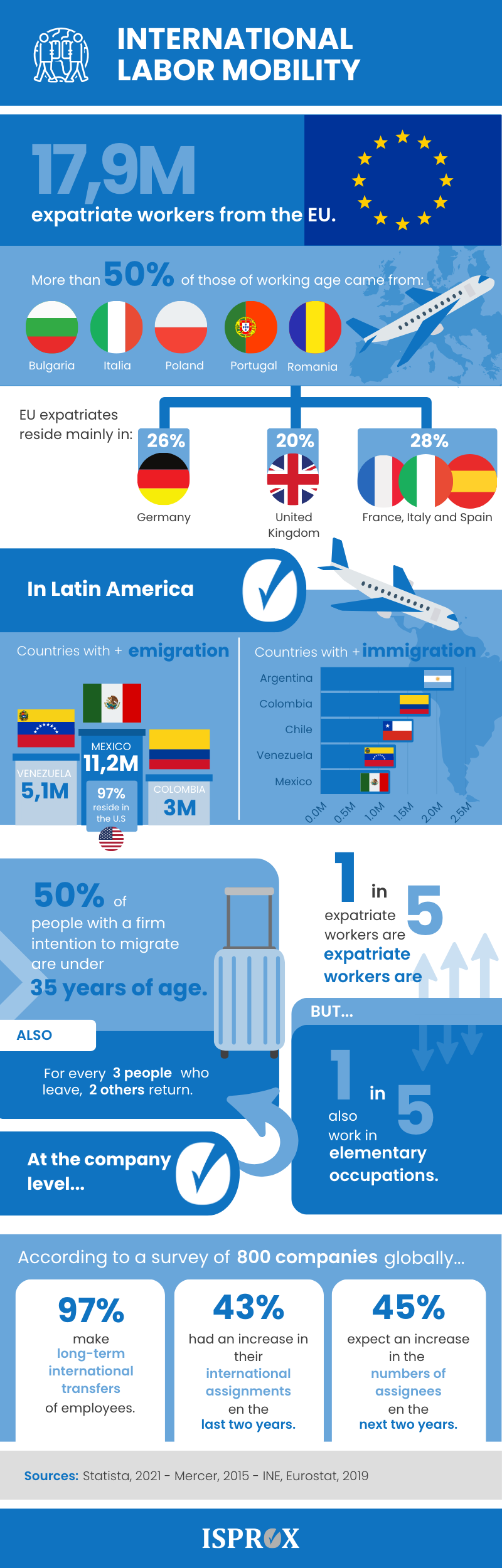
The data in Europe are even more relevant. The 2020 Annual Intra-EU Labor Mobility Report, produced by the European Commission, is very revealing. In 2019 there were almost 18 million expatriates for work-related reasons within the EU. In fact, and despite the negative influence of the pandemic, their presence increased by 1.2%. In terms of gender, there is hardly any difference: 51 % of European expatriate workers were women and the remaining 49 % were men.
"In 2019, the European Union counted nearly 18 million expatriates for work."
It is striking that Germany, the United Kingdom, Spain, Italy and France took in more than half of the displaced workers. Romania, Poland, Portugal, Bulgaria and Italy were the main exporters of workers.
Increasingly, these figures include business travel. Companies have globalized and operate in different markets and scenarios. They increasingly need to be able to relocate their employees according to their own strategic criteria.
Are you looking for talent to expand your team?
At ISPROX we help you find the right profile, saving you time and increasing your hiring success rate.
The benchmark for labor mobility par excellence is still the United States. However, there are some differences between the European and American realities. There is one key barrier they lack: language. In Europe, a large proportion of job movements between countries require fluency in a second language.
Moreover, Social Security benefits are transferred earlier and more easily in the United States than in the European Union itself. All in all, the concept of the American dream is a valid, inspiring reference for many of these changes of residence for work reasons.
Main factors driving this labor mobility
Globalization is both a cause and a consequence of the new times. Among the keys to labor mobility, the following stand out:
New professional objectives. Today, people who wish to prosper and grow in their professional activity assume the possibility of changing residence. Facing a job challenge, seizing an opportunity, completing a career plan or earning more are real motivations for moving to another country.
The world without barriers. Any company can now work on an international scale. Selling to other countries, opening branches or operating in other markets has never been so simple, productive or immediate.
New educational approach. Current educational systems favor the conception of the world as a global labor market. The new generations assume this reality much earlier.
Innovative communication technologies. The development of the Internet, new technologies and telecommunications has shortened distances psychologically. Those affected by this labor mobility can maintain closer contact with friends and family than before.
Improved transportation. This is another vital aspect of this boom. If you have to travel outside your country, you can do it with comfort, simplicity and economy.
Industrialization and digital transformation. In this context, the greater potential of companies tends to require international expansion.
Types of geographic mobility in the workplace
Geographic mobility involves a change of work center to another located outside the place of residence. The company usually makes this decision for three reasons:
Technical considerations.
Production reasons.
Organizational reasons.
When the change of headquarters takes place within the same city, it is not considered geographic mobility. The obligation to change domicile makes a difference and includes international mobility, which involves changing country.
You must differentiate between two types of labor mobility:
Displacement. It is a temporary situation. The change of residence and place of work is not permanent. It will never exceed twelve months in three years.
Transfer. It is a definitive change, individual or collective. Its duration is indefinite or exceeds twelve months in a period of three years.
Another category of geographic mobility at work is called collective mobility. It occurs when:
Involves all persons in the same work center where there are more than five employees.
Within ninety days after the event: 1. Affects ten employees in companies with one hundred workers. 2. Applies to 10% in companies with between one hundred and three hundred workers. 3. Involves thirty professionals in companies with more than three hundred.
Management of labor mobility communication
The company must communicate its decision with the legally established advance notice:
In the case of a transfer, thirty days' notice.
In the case of a trip of less than three months, with a reasonable margin. When it exceeds this duration, five days in advance.
However, it is good for the company to act with empathy and understanding. Talking to the employee as soon as possible is always positive. It is even advisable to explain and agree with him/her the situation beforehand, so that he/she does not end up experiencing it as an imposition.
What a worker can do about it
There are some legal differences between transfers and displacements. However, in general, there are three possibilities:
Accept the company's decision and move to the new workplace with financial compensation.
Challenge the decision in the labor courts. In such case, the judgment may or may not be upheld.
How to manage international labor mobility
Any change of job generates complications. When it takes place between different countries, it involves a vital change that is more than complex. From the company's point of view, you have to understand, it also involves added difficulties. This people management is always complicated.
There are several decisive aspects for the successful implementation of the transfer or displacement policy. We will comment on the main ones.
Motivation and involvement of those affected
If we impose this change, the productivity of the professional will suffer. There is also the danger of losing him or her, but human talent is a very valuable asset that you must protect. For this reason, communication and empathy are essential. Each employee must feel part of the new situation. Knowing the circumstances and motivations that support or require this decision helps to assimilate it without breaking confidence, commitment or efficiency. Of course, the company must also make every effort to facilitate the employee's incorporation into the new job.
Consolidation of hierarchies
When a company's teams and individuals diversify their locations, the organizational structure can falter. Management must work on properly dividing the functions of sites and departments. It is important to reduce duplication, promote the work of managers and enhance business unity. The organizational culture needs to be strengthened in the right way.
Performance evaluation and recognition
We must continue to nurture talent in our company. It is essential, therefore, to be able to measure the performance of our professionals. The main objective must be to reward the quality of the work, especially in those people who have been transferred or displaced. In addition to rewarding and encouraging good work, it allows you to optimize the company's human resources.
Training and support
Remember that, in the European Union, international professional mobility often requires the mastery of a second language. Developing the skills and competencies required for a new position is essential; when it involves a change of country, it is essential. If you put yourself in the right frame of mind, you will soon understand the importance of going beyond the workplace. International mobility involves a personal change of life and the need for integration away from home. This is why we must also train these professionals to make it easier for them to adapt to their destination.
How to facilitate the integration of a worker abroad
Among the data on labor mobility in Europe, it is striking that for every three people who leave, two return. Companies need their employees to adapt perfectly, and as quickly as possible, to their new international positions.
To this end, it is necessary to implement good practices for welcoming and facilitating their incorporation. Here are some of the most important ones.
1. Create an orientation plan for the first few months.
Define who should accompany the professional in his or her new assignment. Make sure they are given a dossier with all the necessary information. Plan a progressive and staggered training, as well as the assumption of responsibilities.
2. Inform as soon as possible
Streamline the process as much as possible and establish, as soon as possible, the arrival and entry dates of the professional. Coordinate with Human Resources and pass this information on to the people in charge of their new position so that they can prepare everything. Also, provide this information to the professional immediately: this will enable them to better manage the preparations for their departure.
3. Accelerates the interrelationship
Information helps a lot in human relations. Send a report with the newcomer's Curriculum Vitae and background, information about his or her family, qualities, age and circumstances. It is also advisable to include a brief explanation of the motives and objectives pursued with this transfer or displacement.
Deliver similar information to the employee. If you know in advance what it is like, how it works and who is responsible for your new assignment, your integration will be faster. It is a good idea to include a directory with photos, names, positions and responsibilities of their new colleagues. Don't forget that he/she will be moving to a country different from his/her own; this will make things easier for him/her.
Complete the documentation with useful information about the destination country. Include information on customs, food, formalities and anything else that may help the professional and his family.
4. Set an agenda for the first day
First impressions are key. Tuck the newcomer in with complete and bearable timing. Visiting the facility, meeting with your supervisor, learning about policies and procedures, etc. are some of the necessary activities.
A formal presentation should also be scheduled with the key professionals in your work. There may be an initial group meeting, but it is important to facilitate private conversations as well. At the beginning, these people should make sure that the new employee gets along well and knows everything he or she needs to know.
If he/she has arrived alone, it is advisable to accompany him/her at the beginning on certain social outings: eating, shopping or getting to know the city, for example. If he/she arrives with a family, it is very productive to encourage the rapid arrival of its members.
5. Boosts and enhances feedback
After the reception comes the loneliness. Especially at the beginning, it is essential that your new colleagues and supervisors take an interest in your impressions. Consider your emotional state, your confidence, how well your expectations are being met and how things are going for you. If something is going wrong, catching it as soon as possible is essential to counteract it.
6. Betting on mentoring or coaching
Encouraging these initiatives within your company is very effective, as well as rewarding for everyone. It promotes a more positive experience and provides immediate practical support for any shortcomings or concerns.
Ultimately, the success of a foreign worker in his or her new destination depends, above all, on his or her dual integration:
To the workplace.
To the environment.
The attitude and actions of the employer and supervisors are decisive. It is necessary:
Create an inclusive environment.
Provide the appropriate human support.
Train the employee for his or her new reality.
International labor mobility, therefore, requires resources, time and awareness from the very beginning. It is important to involve those involved in the decision and to communicate the news transparently to all concerned. Afterwards, it requires you to provide maximum support to those affected to facilitate their integration... and to continue to make the most of their talent.
¿Te resultó interesante este artículo? ¡Compártelo con tu red!
Usamos cookies propias y de terceros para fines funcionales, de preferencias, analítica y marketing.
Puedes aceptar todas, rechazar las no necesarias o configurar tus preferencias.
Política de Cookies.
Las cookies necesarias se usan siempre porque son imprescindibles para el funcionamiento del sitio.
Preferencias de cookies
Imprescindibles para el funcionamiento básico del sitio y la seguridad. Siempre activas.
Guardan tus ajustes como idioma o región.
Nos ayudan a entender cómo usas el sitio (por ejemplo, Google Analytics).
Permiten personalizar publicidad y medir su eficacia (por ejemplo, Meta/Ads).

.svg)
 Spanish - Spain
 Catalan
 English
 Portuguese
 French
 Spanish - Mexico