The world of work has changed a lot in recent years. The digital age has changed many jobs and the ways in which jobs are advertised and howweapply for jobs.
But if there is one thing that has survived all these changes, it is the Curriculum Vitae. It is true that, like anything in this world, it has had to reinvent itself to stay alive. ‘Renew or die'.
In this article we will explain what an executive resume is and how to make it, what differentiates it from other curriculum and some tips to keep in mind.
Shall we start?
What is an executive curriculum and how does it differ from a "regular" resume?
Before we explain what an executive curriculum (also known as a managerial resume) is, let's briefly recall the definition of a Currículum Vitae.
Curriculum vitae means "life's career" in Latin, and it is a document that summarizes our professional lives: education, work experience, skills, and personal accomplishments.
The resume is an essential tool to offer our services to a job offer, as it provides an overview of who we are and what we can offer. It is typically used to apply for a job, but also for scholarships, grants, internships, and any other opportunity in our professional careers.
Features of the Executive Curriculum
Now that we know what a curriculum vitae consists of in general terms, let's explain what an executive curriculum vitae is.
An executive CV is a resume with the following particularities:
Highlights an individual's skills, experience, and accomplishments in senior management positions.
It is designed to highlight leadership and decision-making skills.
The importance of this type of curriculum lies in the fact that employers are lookingfor specific skills and experience from this type of candidate, such as leadership, decision-making, risk management, or problem solving.
Therefore, the executive CV should focus on highlighting these types of skills. That way, the person making the hiring decision can quickly assess whether the candidate is right for the job.
As with any resume, the executive can include references and testimonials from previous business managers that support the candidate's skills and experience. References are often an effective way to demonstrate these abilities to lead and manage projects and teams.
Tips for making an Executive Curriculum
When it comes to writing an executive CV, many people can get stuck or misunderstand the requirements of the CV. We will provide a series of tips on how to write an executive CV correctly:
Know our audience and adapt to it
Before sending our executive curriculum, we should do some research on the company for which we are going to apply as candidates and adapt our executive curriculum to it.
In addition, we should highlight the skills and experience that are most relevant to the position for which we are applying.
For example, if the company is in the finance world, we will be sure to highlight our financial experience on the curriculum vitae.
Some of the skills that can be added to an executive's resume are:
Leadership: Demonstrate and use leadership and negotiation skills to guide the team to achieve the company's goals.
Project Management: Develop the skills and experience to successfully manage projects.
Communication: Develop effective communication skills to persuade and convince others.
Resource Management: Effectively manage company resources to achieve the best results.
Analysis: Analyze and evaluate situations and data to make effective decisions.
Strategic Planning: Plan and develop strategies to achieve organizational goals.
Teamwork: Work with the company team to achieve success.
Business acumen: Develop a business vision to identify new growth opportunities.
Highlight leadership skills
When we apply for an executive or management position, we are expected to have strong leadership skills. We should make sure that these skills are clearly highlighted on our executive CV.
It is very important to include our achievements as a leader, whether it is supervising a team, managing projects, or any type of activity that showcases these types of skills.
Demonstrate experience in decision making
Another key skill to emphasize in an executive CV is the ability to make decisions. This may include:
Strategic decision making.
Decision making in difficult and pressurized situations.
Risk management.
Troubleshooting.
We should make clear in our curriculum how these skills have been used in the past and how we can apply these skills to our "future" company.
Highlighting achievements
In addition to our skills and experience, it is important to highlight our accomplishments on the executive curriculum vitae.
When hiring for a leadership position, employers are looking for candidates who can deliver measurable and tangible results. They want to know how we contributed to the success of previous jobs.
Rather than simply listing our responsibilities, highlight our accomplishments in other jobs. If possible, include examples of how we improved the processes and outcomes of a project.
Using numbers and statistics
People like numbers. And so do HR departments. Employers are looking for candidates who can deliver concrete results to improve company performance.
Numbers and statistics can be a good way to demonstrate your achievements or success. By using quantifiable data on your executive CV, we provide tangible evidence of our skills and accomplishments.
For example, if we have worked in sales, instead of simply stating that we increased sales, we can include a percentage or a specific figure to back up your claim.
These numbers and statistics help make your CV more concrete and convincing, and demonstrate that you have had a real impact on the companies where you have worked.
Use a professional format
This type of curriculum, like any other, must be visually appealing and easy to read. To do this, we must use a professional format and ensure that the design is consistent throughout the document.
Tips to highlight about the format of an Executive CV:
Clear and easy to read.
Clean and professional format with clear Titles and Subtitles.
Bullets and bold type to highlight what we want to emphasize.
It should not be overloaded with unnecessary information.
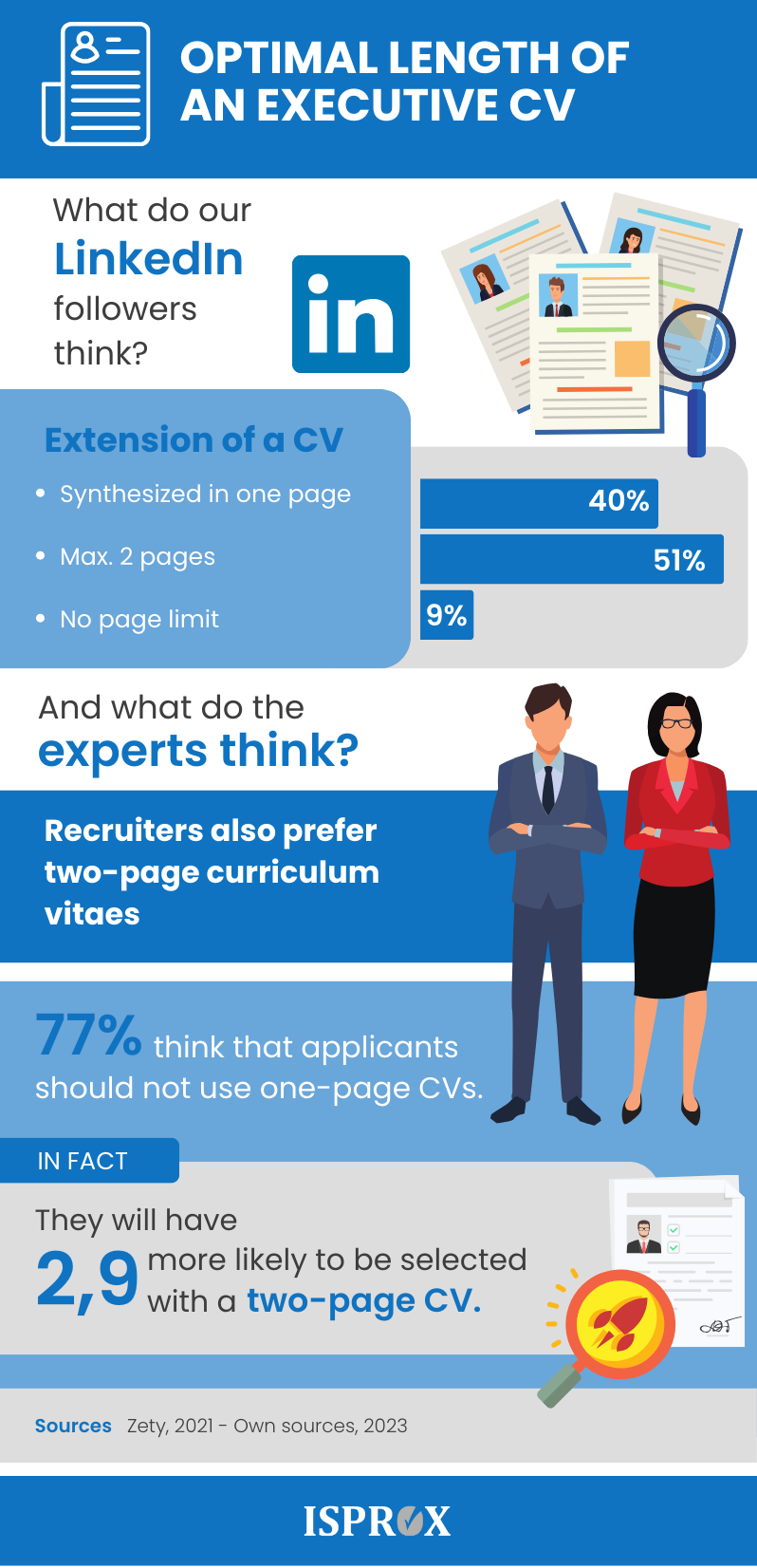
Less is more: the curriculum should not be too long.
Include references and testimonials
For any position and for any curriculum it is advisable to add references from previous employers. But even more so in the case of a managerial resume, since these are positions of responsibility, and any information adds up when choosing the ideal candidate.
Including references and testimonials in your management curriculum vitae can be an excellent way to demonstrate your skills and experience. We must make sure we get permission from the people we mention and that the testimonials are real, relevant and appropriate for the position we are applying for.
Review and edit
Last but not least, we must carefully review and edit our curriculum vitae before sending it. A single typo or grammatical error can make a bad impression on employers.
We should also make sure that the text and formatting are consistent and that the information is clear and accurate.
Once we have completed this review and edited our executive resume if necessary, it is ready to be sent.
Are you looking for a new job challenge?
Register your CV, and from ISPROX, we will contact you if any vacancy matches your profile.

.svg)
 Spanish - Spain
 Catalan
 English
 Portuguese
 French
 Spanish - Mexico