Facing the question about your salary expectations during a job interview can be a critical and stressful moment. This question not only tests your ability to assess your own value accurately but also measures your knowledge of the market and your negotiation skills.
How can you make sure to respond effectively and get the salary you deserve? Discover in this article how to answer the question about your salary expectations in job interviews effectively, and we provide key tips to handle it confidently.
How should you respond when asked about your salary expectations?
Discussing your salary expectations during an interview can be one of the most delicate moments in the process. This question often causes concern, as the wrong answer can influence the employer's perception of your professional value. However, with the right preparation and a strategic approach, you can respond effectively and increase your chances of receiving a fair and competitive offer.
In this article, we will explore how to prepare for this question, what strategies to use to respond effectively, and how to avoid common mistakes. In addition, we will provide you with sample answers for different levels of experience and industries, as well as tips for subsequent salary negotiation. . Our goal is to offer you practical tools and useful advice that will allow you to face this question with confidence and professionalism.
What are salary expectations?
Salary expectations refer to the salary you expect to earn in a new job. This figure is influenced by various factors, such as your level of experience, skills, the cost of living in your area, and market rates for the position you are seeking. Defining your salary expectations accurately and realistically is essential to ensure that both you and your future employer have a mutual understanding of the appropriate compensation for your position in the company.
Keep in mind that employers ask about your salary expectations for several reasons:
It helps them determine whether they can afford to hire you. Every company has a specific budget for each position, and knowing your salary expectations allows them to assess whether your expectations fit within that budget.
It allows you to gauge how much you value your own work and your level of experience. A well-informed response can demonstrate that you have researched the market and understand your professional worth.
It helps prevent future misunderstandings. If there is a significant difference between what you expect to earn and what the company can offer, it is best to address this discrepancy early in the selection process so that both parties can make informed decisions.
If you arelooking for a job, we can help you find an opportunity that suits your profile and advise you on negotiating your salary.
How to prepare to respond to salary expectations?
Answering the question about your salary expectations can be a decisive moment in a job interview. Here are some tips to help you prepare and handle this situation with confidence. We can start by telling you that it is essential to research market salaries for the position you are applying for.
In our experience, we can advise you to use:
Specialized websites: There is a wide variety of platforms that offer up-to-date data on salaries in different industries and locations, such as the Infojobs salary search engine if you are looking for a job in Spain.
Network of contacts: Talking to colleagues and professionals in your industry is a good way to find out about salaries.
Company analysis: You can analyze the salary disclosures of some companies.
Once you have an idea of the market salary, it is important to also consider other factors such as:
Experience and skills: Assess your career path, skills, and achievements. This is extremely valuable in justifying a higher salary expectation.
Education and certifications: Both academic degrees and professional certifications should be considered when establishing your salary range.
Cost of living: Be sure to adjust your salary expectations according to the cost of living in the area where the job opportunity is located.
Additional benefits: It is important to keep in mind any other benefits included in the compensation package. The salary figure is not always everything.
Being well prepared not only benefits you, but also shows employers that you are aninformed and serious candidate.
How should you respond to salary expectations during the interview?
When asked about your salary expectations in an interview, it is important to know how to respond by handling the situation strategically and professionally.
Here are some brief strategies that will be very useful to you:
1. Research and indicate a range:
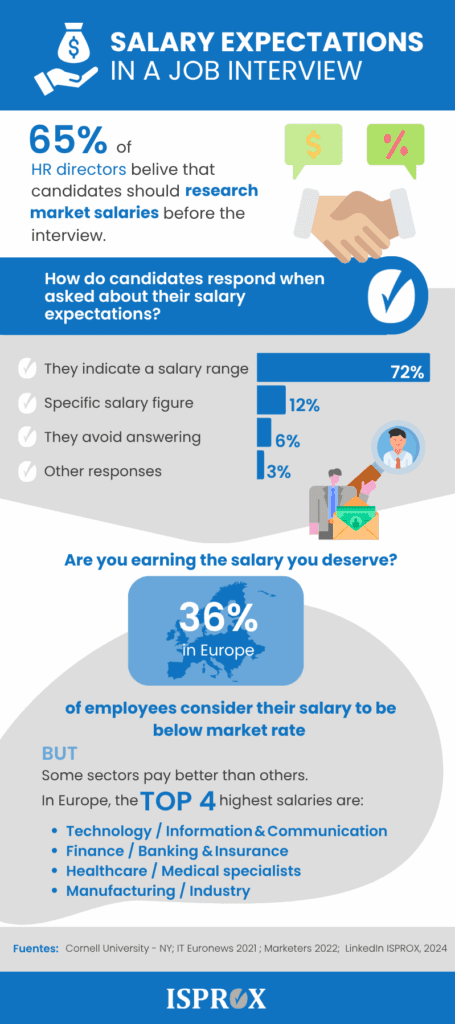
According to Cornell University, 65% of HR managers believe that candidates should research market salaries before the interview. This shows that you are informed and have reasonable expectations.
After researching the average salaries for the position you are applying for, offer a range based on your experience and skills, to leave some leeway for the company and not close any doors. A little flexibility can help you get the opportunity you want sooner.
2. Request information about the company:
Before giving your answer, ask the interviewer what salary range the company has in mind. This allows you to understand their expectations and adjust yours accordingly.
3. Focus on the complete package:
It is very important to consider all aspects of the compensation package, not just the base salary. Mention that your expectations are flexible and depend on additional benefits and opportunities for growth.
With these strategies, you will be able to handle the interview without compromising your negotiating power or diminishing your value.
Examples of how to respond to salary expectations
Answering the question about your salary expectations may vary depending on your level of experience and the sector in which you work. Here are some examples of effective responses for different situations, always maintaining a professional and friendly tone.
For those starting their careers and with little experience:
“Considering the starting salaries in this field and my education and skills, I believe that a range between (X) and (X) would be appropriate. I am open to discussing the growth opportunities and benefits offered by the company.”
For professionals with several years of experience in their sector:
With my five years of experience in digital marketing, and after researching salaries for similar roles, I believe that a range between (X) and (X) would be fair. I am open to discussing this figure and other additional benefits.
In high-demand sectors, such as technology or finance:
With my seven years of experience in software development and my specialization in artificial intelligence, I have found that the normal salary range is between (X) and (X)....
For senior positions:
With over 10 years of experience in leadership roles in the financial sector, and managing projects that increased profitability by 20%, I believe that a range between (X) and (X) would be appropriate.
These examples will help you respond effectively and professionally, adapting to your specific situation.
Common mistakes when responding to salary expectations and how to avoid them
It is important to keep in mind that discussing salary expectations during an interview can be a sensitive topic. Here are some common mistakes and tips on how to avoid them.
1. One of the most common mistakes is not researching market salaries before the interview.
This could be avoided by researching the salary ranges for the position you are applying for, keeping in mind the strategies we discussed earlier.
2. A common mistake is to give an exact figure. According to a survey conducted by the University of Mannheim in Germany, 70% of HR managers prefer candidates to provide a salary range rather than a specific figure, as this shows a willingness to negotiate and flexibility.
Therefore, the best strategy is to have a salary range: “I am looking for a salary in the range of (X) to (X)...”
3. Another common mistake is being inconsistent with your salary expectations during the different stages ofthe selection process. For example, if during an initial phone interview you indicate a salary range and then in a second face-to-face interview they ask you again about your salary expectations and you indicate a different range, you will generate mistrust in the employer.
It is important to indicate the same figures in your salary expectations throughout the selection process to increase your chances of being selected for the position.
4. A huge mistake is to respond in an insecure or hesitant manner, as this can give a negative impression and affect your ability to negotiate.
To avoid this, it is best to practice your response and deliver it with confidence.
Salary negotiation: next steps after responding to salary expectations
Answering the question about your salary expectations is just the beginning. If your answer opens up a negotiation, it is important to know how to proceed to ensure a favorable agreement.
According to a study by the University of Buenos Aires, 60% of HR managers believe that the ability to negotiate after responding to salary expectations is crucial for assessing a candidate's adaptability and communication skills.
Once you have shared your salary expectations and the company shows interest in negotiating, you should consider the following:
Listen carefully to the offer and evaluate it. Allow the recruiter or human resources manager to present their initial offer. Pay attention to all the details, including base salary, additional benefits, bonuses, and any other forms of compensation.
Ask questions. If there is anything you don't understand or need more information about, don't hesitate to ask. This shows that you are committed and want to make an informed decision.
It is important to note that salary negotiation requires a balance between firmness and flexibility. Here are some tips for managing both aspects:
If you believe that your skills and experience justify a higher salary than what you are being offered, defend your position with specific data and examples that reflect your competencies.
You should also keep in mind that if the initial offer is below your expectations but the total compensation package is attractive, show a willingness to negotiate.
Don't forget this last point. Throughout the negotiation, maintain a positive and collaborative tone. According to a study conducted at the University of Lisbon in Portugal, 72% of HR managers believe that clear and effective communication after discussing salary expectations is a positive indicator of a candidate's interpersonal skills.
This can help build a strong relationship with your future employers and facilitate a mutually beneficial agreement.
Conclusion
In conclusion, addressing salary expectations during an interview requires preparation, strategy, and flexibility. It is essential to research market salaries, consider your skills and experience, and present your expectations clearly and realistically.
During the negotiation, listen carefully, evaluate the entire offer, and maintain a firm but flexible stance depending on the context. Remember that salary negotiation is an opportunity to demonstrate your value and ensure fair and competitive compensation.
With confidence and professionalism, you can meet this challenge and achieve a satisfactory outcome for both parties.
Are you looking for a new job challenge?
Register your CV, and from ISPROX, we will contact you if any vacancy matches your profile.

.svg)
 Spanish - Spain
 Catalan
 English
 Portuguese
 French
 Spanish - Mexico